How to Avoid Airbnb Scams Before Booking (A Practical Guide for Travelers)
Booking a place online has never been easier.
In just a few clicks, you can find hundreds of apartments, compare prices, read reviews, and imagine your next trip. Platforms like Airbnb and other vacation rental sites have completely changed the way people travel.
But with that convenience comes a growing problem. More and more travelers are starting to ask the same question: "Can I really trust what I'm booking?"
Because behind the photos and descriptions, the reality is not always the same. Some listings look perfect online but feel very different once you arrive. Others are simply misleading, outdated, or in some cases, completely fake. And the worst part is that you often only realize it when it's too late.
That's why understanding how to avoid Airbnb scams and misleading listings has become essential for modern travelers.
Why Airbnb Scams and Misleading Listings Are Increasing
The short-term rental market has grown rapidly over the past few years. With millions of listings worldwide, it has also become harder to control quality and authenticity.
Some hosts use:
- Heavily edited photos: Wide angles, flattering lighting, and carefully selected shots that misrepresent reality.
- Incomplete or vague descriptions: Key information omitted or glossed over to avoid raising questions.
- Outdated images: Photos from years ago that no longer reflect the current state of the property.
- Listings that no longer exist: Fake or discontinued properties still visible on platforms.
At the same time, demand keeps increasing, especially in popular destinations. This creates a perfect environment for confusion, and sometimes, bad experiences.
1. Don't Rely Only on Photos
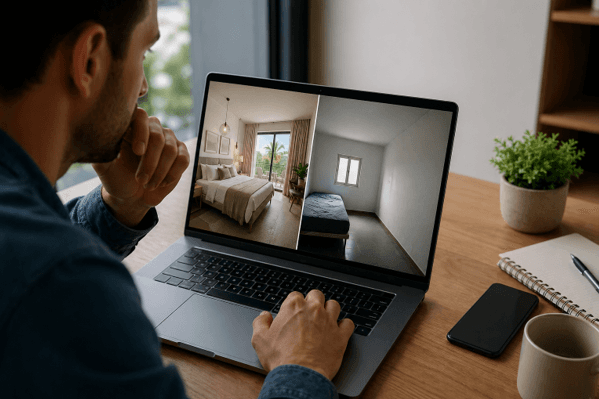
Photos are often the first thing travelers look at. But they are also the easiest element to manipulate. Wide angles can make spaces look larger. Lighting can completely change the atmosphere. And some images might not even reflect the current state of the property.
Instead of trusting photos alone:
- Compare carefully: Look across all photos and spot any inconsistencies.
- Look for missing rooms: If certain areas are never shown, ask yourself why.
- Check for inconsistencies: Different light, furniture, or angles between photos can signal edited or old images.
If something feels incomplete, it usually is.
2. Read Reviews — But Read Them Carefully
Reviews are helpful, but they are not always enough. Many travelers only read the latest comments or focus on the overall rating.
A better approach is to:
- Read both positive and negative reviews: Don't let a high star rating stop you from reading the full picture.
- Look for repeated issues: If multiple people mention the same problem, it's rarely a coincidence.
- Pay attention to details: Cleanliness, noise, location, and host responsiveness are often the first things to surface.
3. Be Careful with Prices That Feel "Too Good"
If a listing is significantly cheaper than others in the same area, there is usually a reason. It could be a less desirable location, lower quality than shown, or hidden issues you won't discover until arrival.
Price Red Flag
While good deals do exist, extreme price differences compared to similar listings in the area should always raise a question — not excitement.
4. Check the Location — Not Just the Description
Some listings use attractive location descriptions that don't fully reflect reality. For example, "near city center" might mean 30 minutes away, and "quiet area" could also mean isolated from everything you need.
Use maps to:
- Verify the exact location: Pin the address and check the surrounding streets carefully.
- Check nearby places: Are there shops, transport, and restaurants? Or is it more remote than described?
- Understand the real environment: Street view can reveal a lot that listing descriptions leave out.
5. Ask Questions Before Booking
One of the simplest but most effective steps is to ask the host direct questions before committing. For example:
- Are the photos recent?: A good host will confirm without hesitation.
- Is the apartment exactly as shown?: Specific questions get specific answers — or reveal vague ones.
- Are there any ongoing issues?: Renovations, noise, or maintenance can affect your stay significantly.
A clear and fast response is often a good sign. A vague or delayed response is not.
6. Look Beyond Listings: The Importance of Real Verification
Even after checking photos, reviews, and location, one thing remains: you are still booking something you haven't seen.
And for many travelers, that uncertainty is the real problem. This is why more people are starting to look for ways to verify accommodations before booking — especially for longer stays or important trips.
Because at the end of the day, the goal is simple: to know exactly what to expect.
Want someone local to verify a property before you book? Discover how CheckerIst works
Final Thoughts
Travel should be exciting, not stressful. But when uncertainty becomes part of the booking process, it affects the entire experience.
Avoiding Airbnb scams is not about being paranoid. It's about being informed. By taking a few extra steps before booking, you can reduce risks, make better decisions, and enjoy your trip with more confidence.
Because the best trips don't start when you arrive. They start when you feel sure about your choice.